

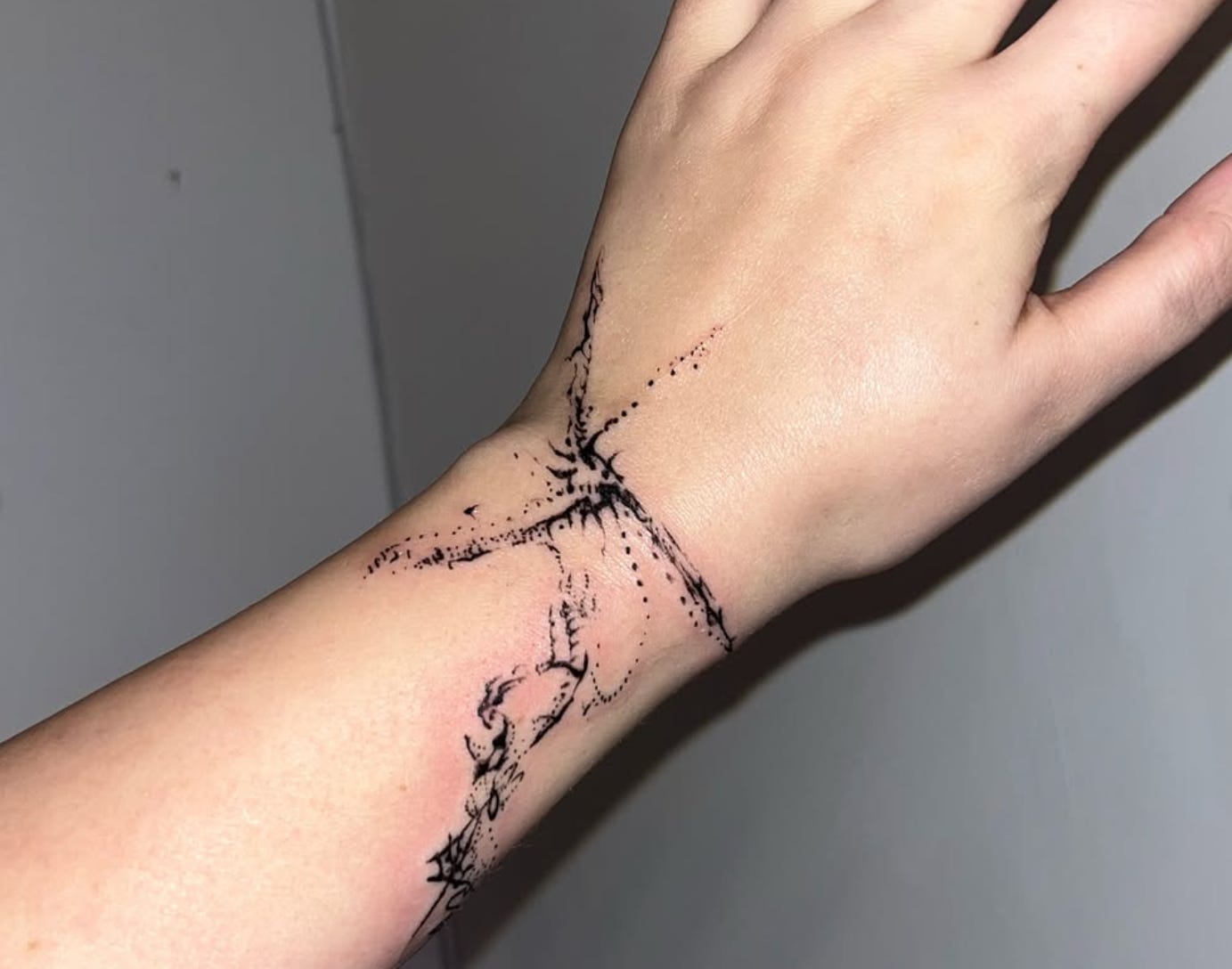
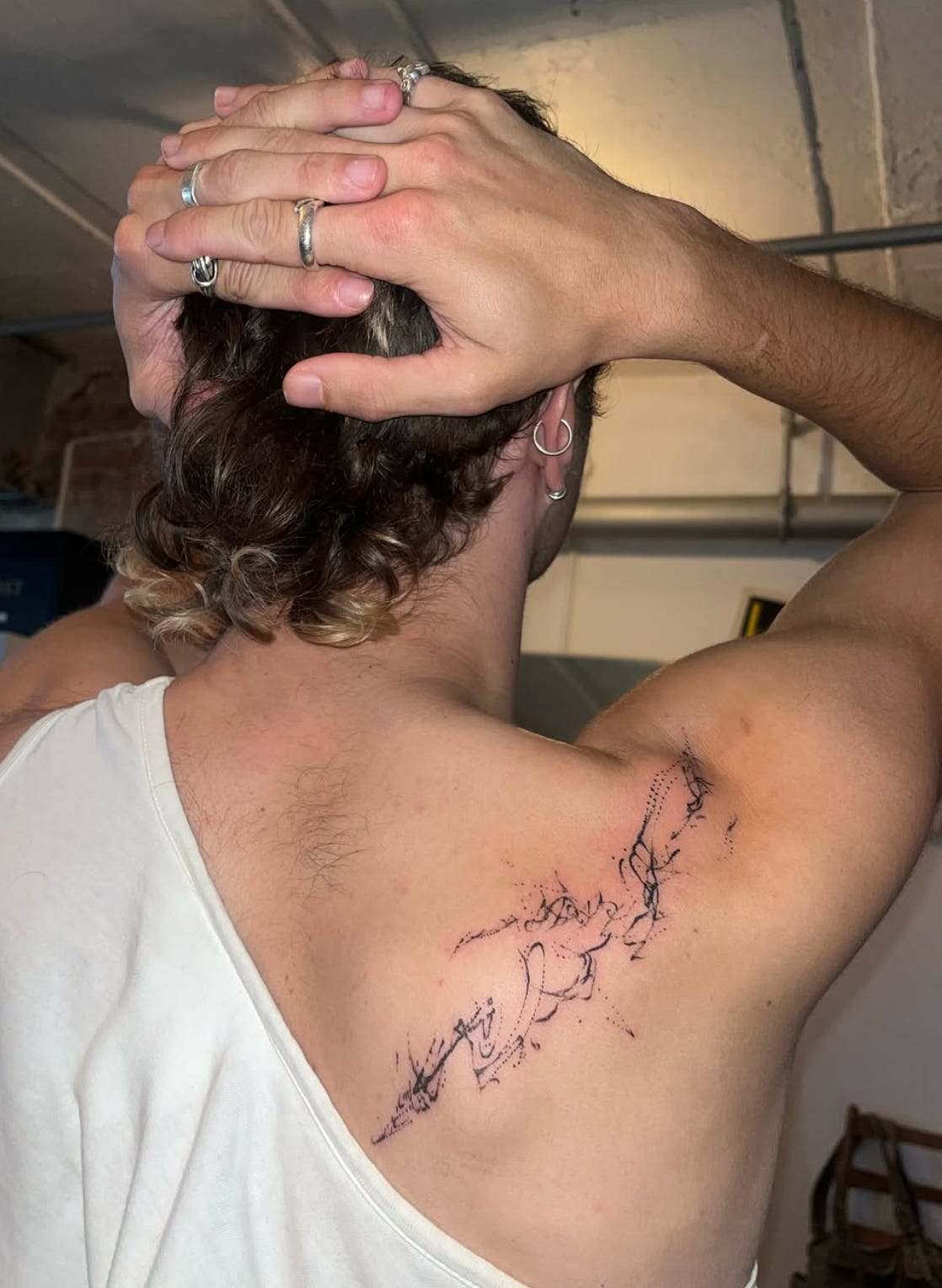
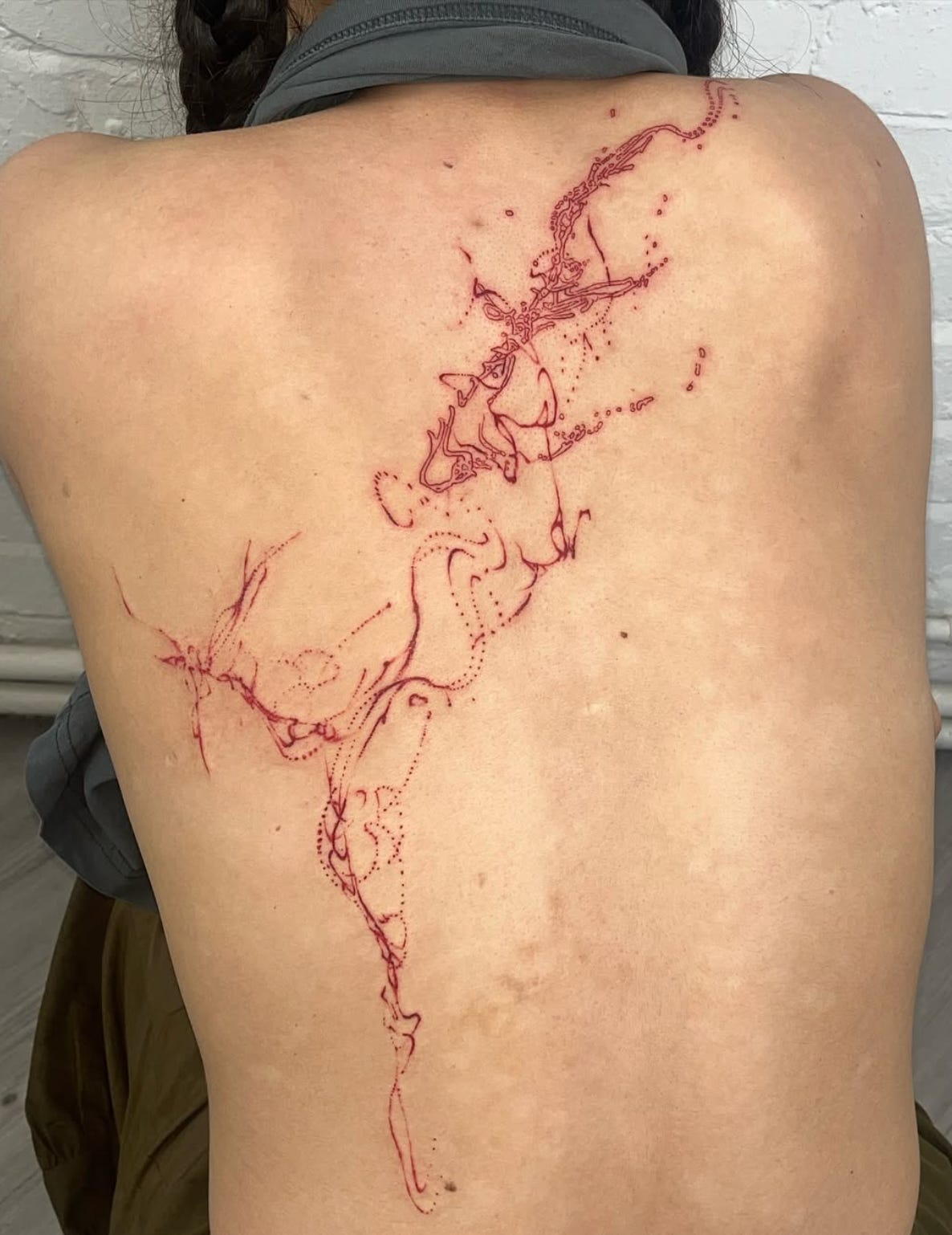
Sentimental voice recordings of loved ones; fragments of song. Min Yu turns these sounds into visual forms and inks them onto skin. Working out of Concrete 01 in London, and previously Good Soup Studio, you might know her as Yum Ink—a clever play on her name. Her practice, which she calls audiovisual tattooing, has a rare quality that lingers. It brings to mind the old Windows Media Player visuals, any of you remember those?
We met on a cool morning in Dalston. Walking over to Cafe OTO together, we settled outside as the city moved around us with its sirens and honks. At one point, she bumped into someone she knew, and later told me the same thing had happened on her last trip to Paris. There’s something comforting about finding familiar faces in big cities, and how tattooing creates those connections both in person and online.
What struck me most about Min wasn’t just her gift for the craft. She holds space with intention for the deeply personal stories her clients share, while carrying the emotional weight that comes with them. A person first and foremost, she’s shaped by practices across art, music, and tattooing. I just feel very lucky that I’ve been able to make them work together instead of against each other, she says. Already deeply skilled, yet feeling she’s only at the very beginning.
When we spoke, she seemed to be in a reflective, transitional season—mulling over a newfound responsibility and vulnerability, while believing in the beauty of beginning again whenever she chooses. That sense of starting over isn’t just hers, though, it’s a reminder for all of us. An ongoing self-reckoning. As she put it, How can I say I’m just one thing when I’m not?
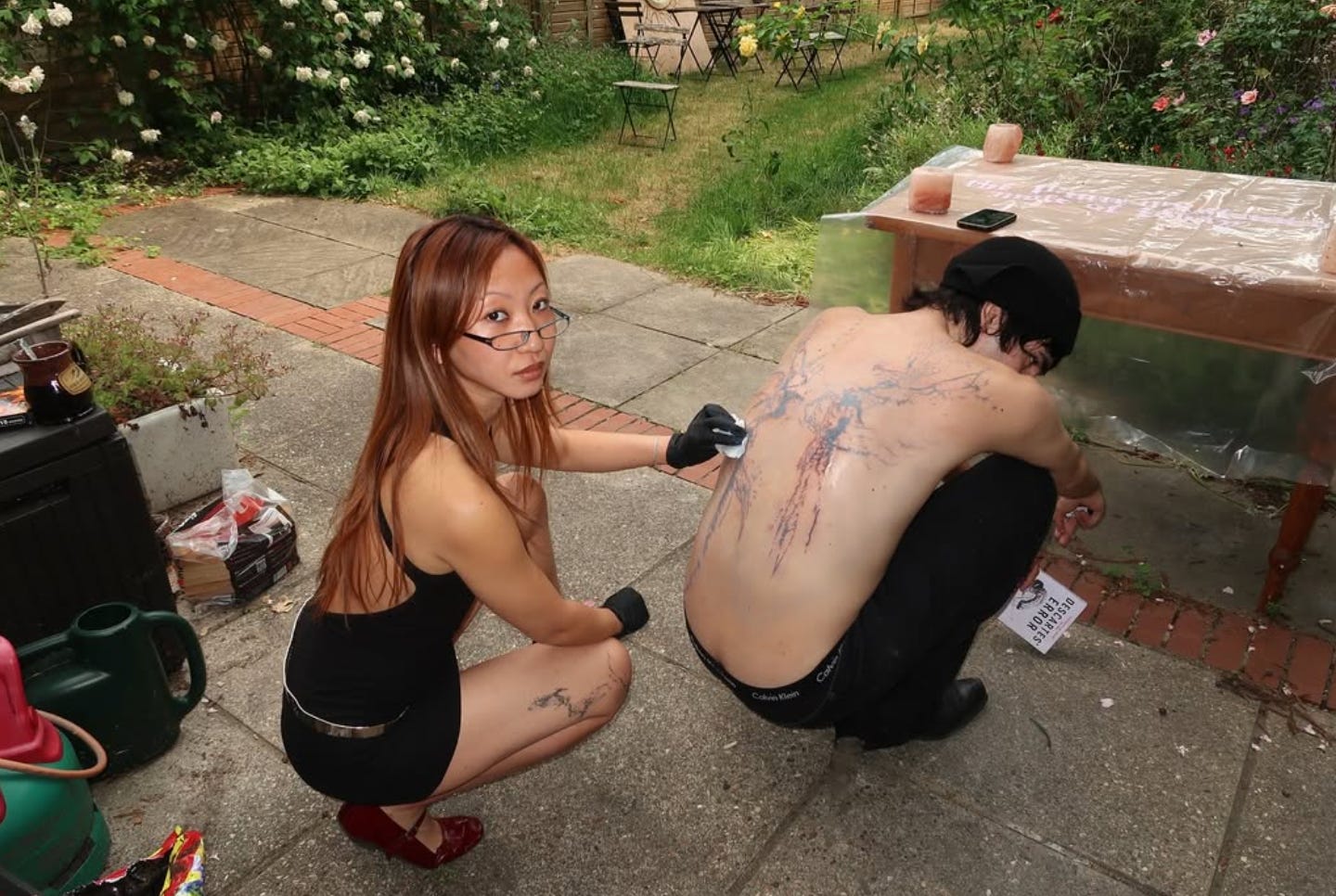
PIN: Earlier you mentioned that most of your works are customs as opposed to flashes. That makes sense to me, as it seems less likely someone would want to tattoo a sound without any personal significance.
MIN: From what I've seen, it really varies. Some tattoos are deeply sentimental; others, less so. There have definitely been times I’ve gotten emotional listening to the audio myself. Sometimes it gets too much, and I have to switch off the sound, I can't keep on connecting with it. I try not to get too attached because, at the end of the day, I see myself more as a vessel for someone to express something.
PIN: It’s almost like an actor getting a script. In your case, it's about understanding why this means so much to them in the first place. Then you want to capture that for them in the best way possible. I can see where the emotions come in, but sometimes it costs you.
MIN: I love hearing people’s stories and why they want a particular tattoo. But when something is really emotionally significant for someone—and rightly so—they get more attached, and there are more expectations.
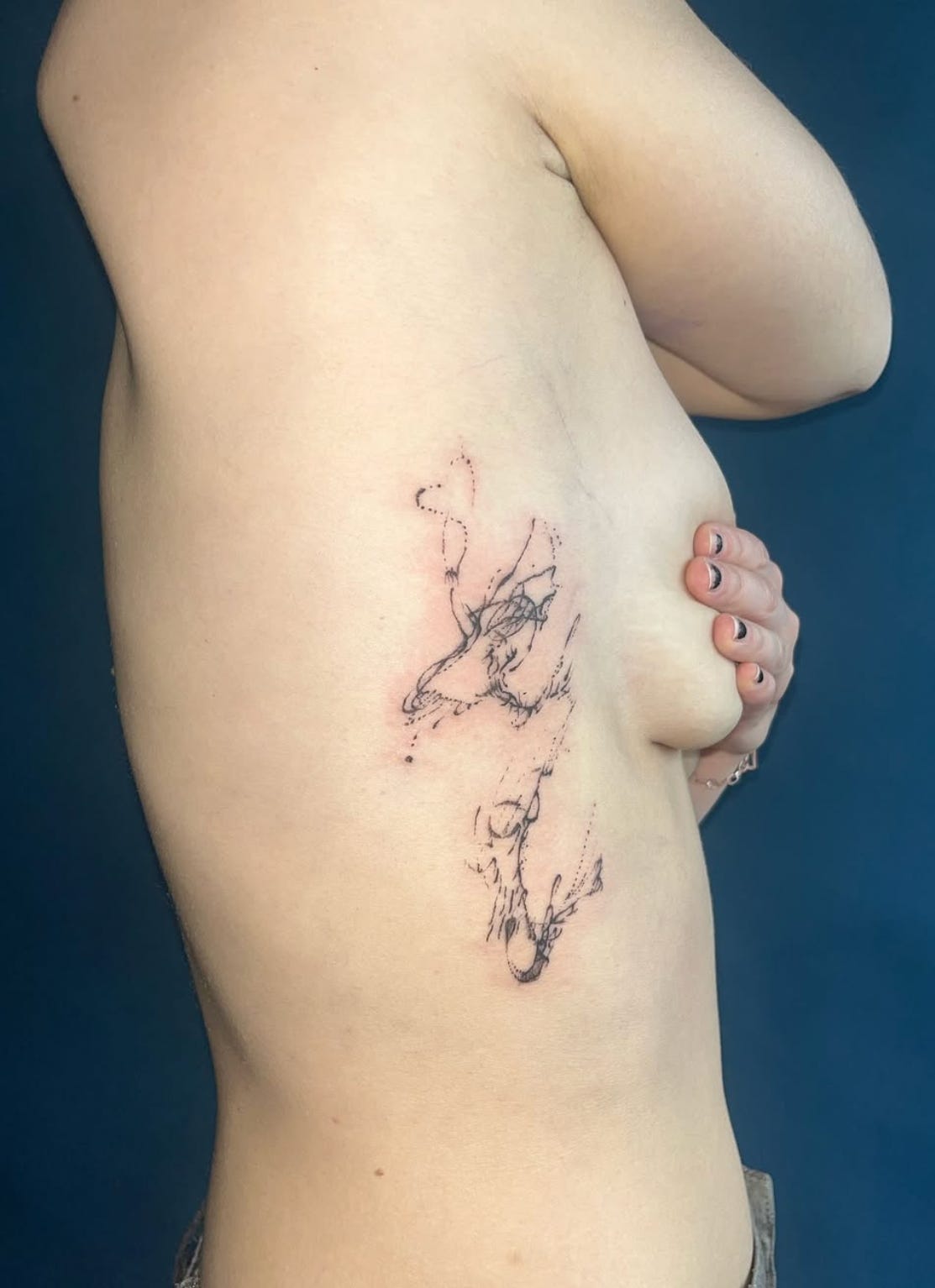
I tend to take on the emotions and carry them with me. I'm still figuring out a healthy way to release that, so it doesn’t take over. There’s a fine balance being emotionally present and being professional. Tattooing is fun, but I didn’t realise how exhausting it could be. Yet, even though it's only been ten months, it's changed my life massively. I think I'll be doing this for another five years probably, and that would kind of be me.
PIN: What do you think comes next?
MIN: I’m a bit of a nerd. I really want to continue exploring what I was doing before—immersive music and non-linear composition—but in a different way.
Immersive music is spatial: you can walk around a space, and the music shifts with you. An example of it is game music, where you control a character moving through space, and everything is immersive. You have to create an intuitive environment that doesn’t pull the listener out of the experience.
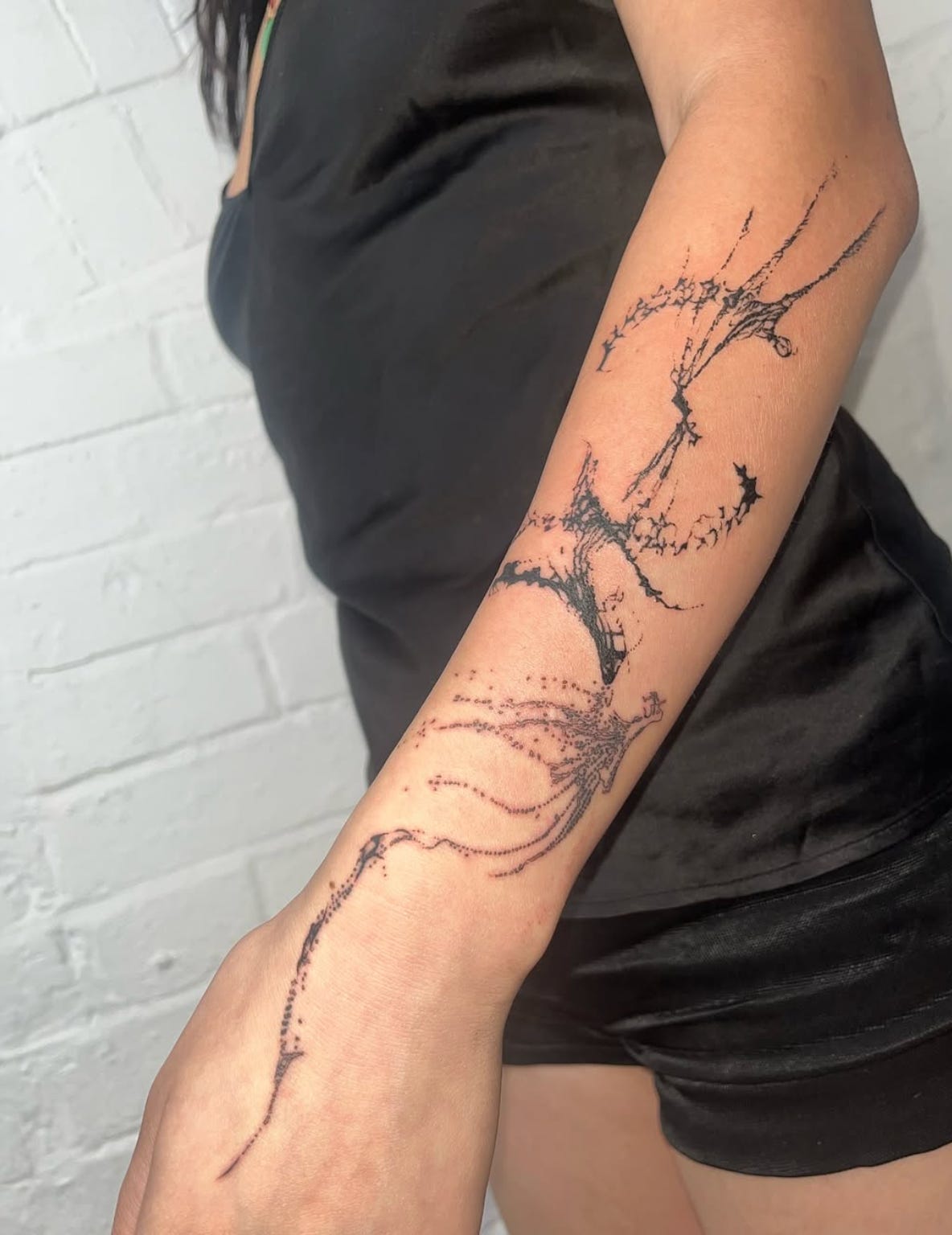
PIN: It’s exciting that you have different paths you could explore.
MIN: I think most people have lots of interests and opinions. I feel lucky I’ve been able to make them work together instead of against each other. That’s the hard part: combining your interests so they exist harmoniously. Even now, I feel like I’ve only figured out level one of that. I still feel like a jack of all trades, dipping into a bit of everything without mastering one thing. Imposter syndrome definitely creeps in, like it does for most creatives.
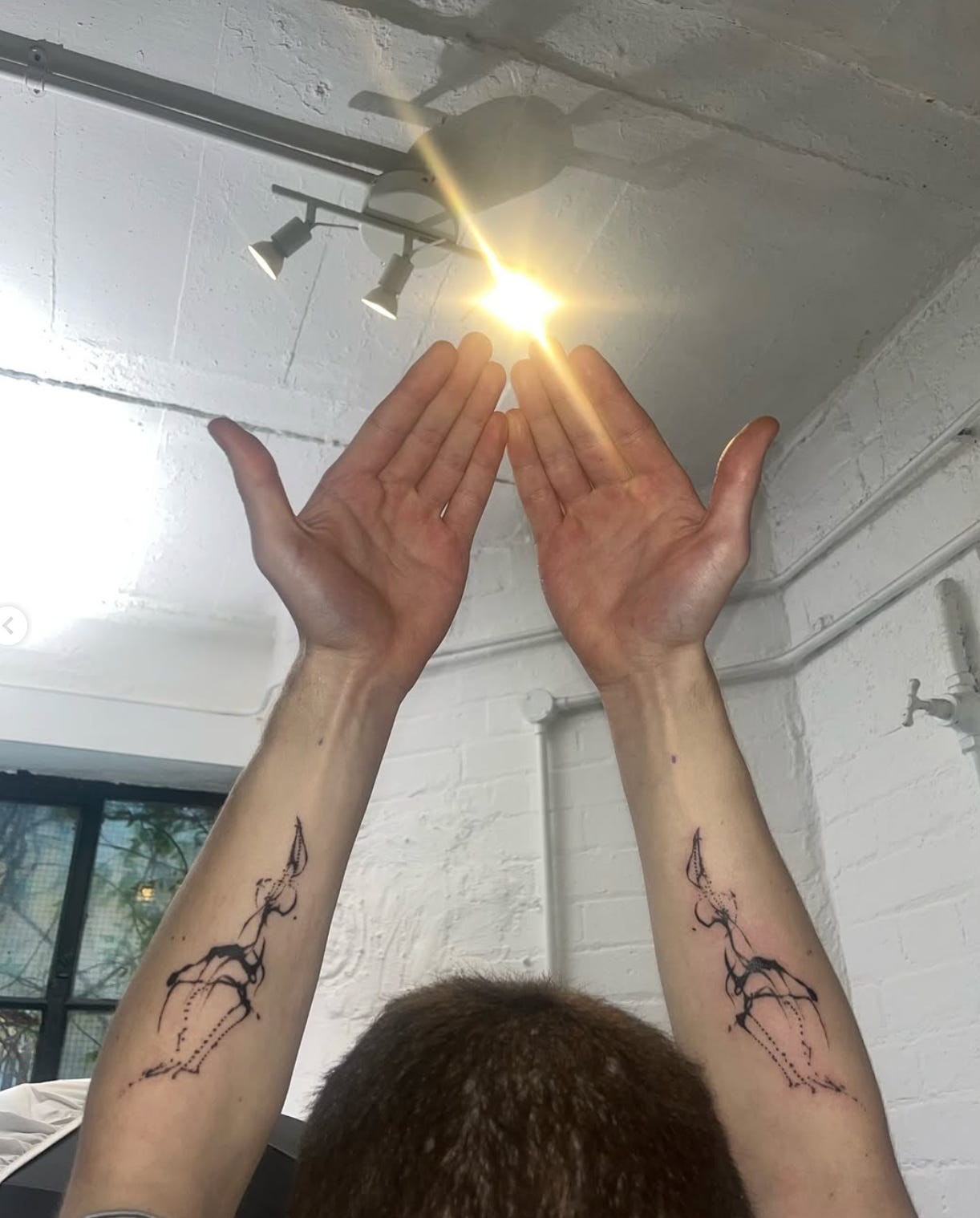
PIN: How do you make sense of all of that? Are you interested in mastering ‘one thing’?
MIN: It’s a double-edged sword. I love being a Swiss Army knife, interested in everything and eager to explore. But it does mean I don’t have a clear focal point. I end up spreading my energy across everything, so each thing progresses a little rather than one thing progressing a lot.
This is just how I work. Whether I like it or not doesn’t matter. I don’t think I could ever focus on just one thing, it doesn’t feel natural. So yeah, I’ll be a bit all over the place, that’s what we’re working with.
PIN: I relate to this as well. I envy specialists, and when I try to unpack why, I realise it’s about perceived identity. They can be known as a great Illustrator, or a Photographer. At the same time, I’m realising: this is who I am, I’m not one thing, and I need to work with that.
MIN: That is interesting to me. I hate calling myself a tattoo artist. I’m so much more than that. I don’t want people to look at me and go, “She’s just a tattoo artist.” I am a tattoo artist, but I am also a musician, and I am also an artist. I studied conceptual art in school and worked at a sound design company.
This goes even deeper because I’m Chinese and British. The binary of labelling myself has always been hard. How can I say I’m just one thing when I’m not?
What I love about our generation is that we can do whatever, whenever we want. People can constantly start over, have multiple jobs, experience different things, and not just career-wise. That’s a privilege older generations didn’t have. For them, it was train for one thing, and that’s your life. Now, among the people I know, none of us want to be just one thing. We want to be this thing, and also another thing, and another, and another. I find that really admirable. The challenge is managing it all and finding peace with doing maybe just one of them at a time.
PIN: It’s like this tension where we’re pulled in different directions, and what we’re seeking is resonance.
MIN: I’ve felt that since I was a kid. I started piano and art at four, doing both through school, university, and my master’s. Even in my old job, I was always asking: what do I choose? When I was in undergrad for art, I wanted to do music. I made music for animations, then pursued a music master’s.
It’s a never-ending question: what path do I take? Both are valuable and important. I feel like I’ve found a middle ground, but balancing is still a work in progress. It’s like standing on a plank over a sphere, doing this little balancing act rather than choosing left or right.
PIN: How has this balancing act evolved for you?
MIN: It hasn’t progressed much yet. There are always curveballs—being self-employed, managing physical and mental health, taking responsibility for someone else’s body.
PIN: The plank gets longer and longer. I think what’s interesting is that you’ll get better at balancing, but there will always be curveballs because you’re growing, and that will bring new challenges.
MIN: It’s such an early stage of my career, and new situations often arise. In this profession, you work intimately with people, their bodies, and their mental health. I’m learning to take care of myself and others at the same time.
PIN: You’ve started keeping records of the stories behind the audio notes your clients share. What prompted that?
MIN: Over time, the urge grew stronger. Taking responsibility for others can feel heavy because I understand how important this is to them. I want to hold space, but I can’t keep it all in my head. Writing it down gives it a physical form and releases the emotions. I think right now there’s also that fear, of forgetting something so important. It’s a way to remember, a way to reconnect if needed, and I also think they deserve to have their own space outside of my head.
PIN: What’s something you’ve learnt about yourself along the way?
MIN: Maybe that I’m a little bit more vulnerable than I thought. My whole life, I’ve been making decisions for myself, and I’ve been so comfortable with that. I know what I want quite quickly. I never had much trouble just changing myself whenever I needed to.
But now, being responsible for other people: you’re playing an important role in someone’s life in a very short amount of time, like when you’re tattooing someone with a piece that’s deeply tied to their culture. Suddenly, I felt really vulnerable.
People have always said I’m responsible my whole life, and sure, it is easy when you’re only responsible for yourself. But when it comes to others, I find myself thinking: I don’t know how to do anything. Everything feels so new. The ways I used to make decisions for myself, they kind of go out the window. This is a completely different context, and I don’t even know where my intuition lies anymore.
It’s made me really question how I relate to the world—not just as myself, but with other people. That shift feels massive, like a big transitional period. It’s a lot to hold, but it’s been really good.

